
Find People Across Indian Trail
The best first record depends on what is already known. A full name fits the county tax roll, the statewide court party search, and the voter lookup. An old address works better in Union County Property Tax Inquiry or UC Atlas. A family event belongs with the Register of Deeds, the Clerk of Superior Court, or a historical collection. Indian Trail Town Hall has the local layer: staff, council, planning, code, development, and Town-created correspondence.
Do not treat one hit as proof. A mailing address can belong to a tax recipient, agent, or post office box. A court entry may concern another person with the same name. Match at least two details, such as middle name, parcel, age range, case number, relative, or prior address, before joining records into one person’s trail.
- Try the exact name and a few careful variants in a suitable official index.
- Use Union County property tools when an address or owner is known.
- Check eCourts by party name, then narrow to Union County and the right case type.
- Follow family links through vital, estate, obituary, church, and directory sources.
- Ask the correct custodian for a defined record when the web portal stops.
Indian Trail People Search Offices
Indian Trail is an incorporated town, but Monroe is the Union County seat. That split decides where to search. The Town Clerk keeps Indian Trail administrative records. The Register of Deeds records land instruments and issues local vital certificates. The Clerk of Superior Court holds case, estate, judgment, and special-proceeding files. Tax Administration and GIS connect owners with parcels and municipal boundaries.
These offices answer different questions. The Register records documents but does not decide title or give legal advice. The clerk’s case file can explain the authority behind an estate transfer. Town Hall can identify an applicant, owner, speaker, board member, or contractor in local files. Full access rules and copy procedures are handled on the Indian Trail public records page.
Union County Register of Deeds
500 N. Main St., Suite 258
Monroe, NC 28112
704-283-3843
Indian Trail Town Hall
315 Matthews-Indian Trail Road
Indian Trail, NC 28079
704-821-5401
Indian Trail Property Search Path
An address often gives a faster start than a broad name query. The Union County Property Tax Inquiry accepts a property number, owner name, or address in one field. Advanced controls can narrow land value, improvements, taxable value, acreage, sale price, sale date, municipality, and neighborhood. Note the exact owner spelling and keep the physical site address separate from the tax mailing address.
The captured tax portal shows the practical entry point for an Indian Trail owner search.
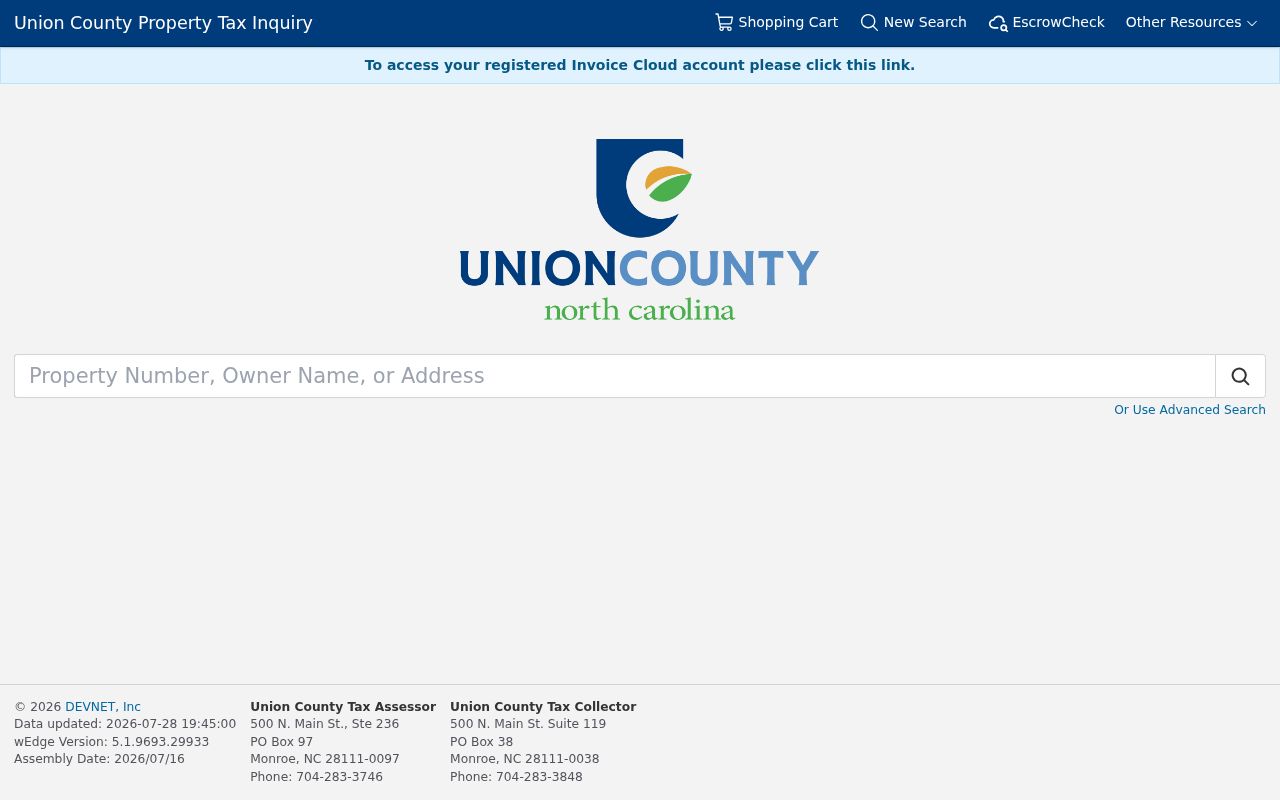
A result can supply the parcel key needed for GIS and the indexed owner name needed for deeds. It does not prove who currently occupies the home.
| Starting fact | First lookup | Next record |
|---|---|---|
| Owner name | Tax Inquiry | Parcel, deed, or mailing address |
| Street address | Tax Inquiry or UC Atlas | Owner name and parcel |
| Parcel number | UC Atlas | Boundary, subdivision, and nearby lots |
| Former owner | Deed index | Earlier transfers or estate file |
Check Indian Trail Search Boundaries
A postal address that says Indian Trail may sit outside the Town limits. Town project files also show parcels divided between the municipality and unincorporated Union County. That difference can change the planning, code, map, or records custodian. Check the Town’s current boundary map or use the municipality information in UC Atlas before sending a request.
The UC Atlas mapping hub offers owner, parcel, address, subdivision, street, acreage, and sales searches. Its tools include aerial imagery from several years, measurements, identification, printing, and an extent-based CSV export.
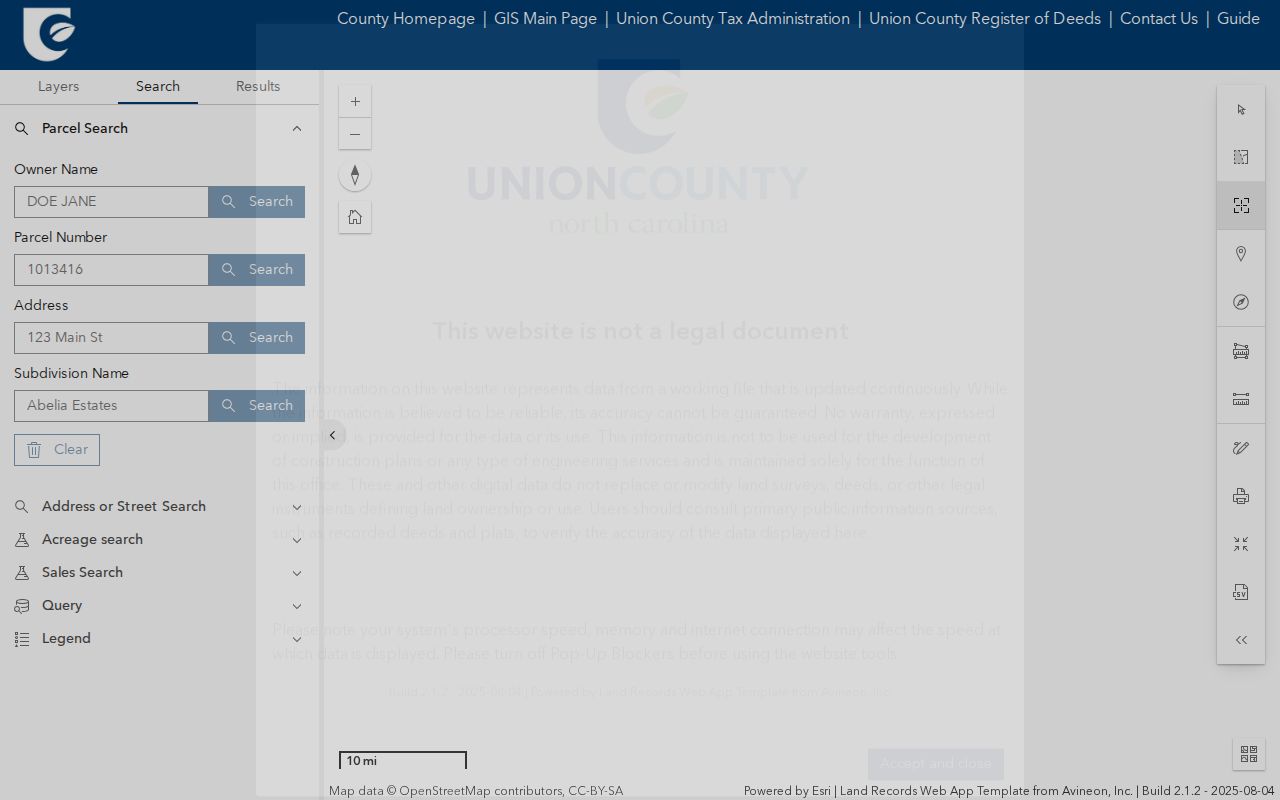
The map helps place a person or parcel in context, but the county warns that it is not a deed, legal description, or survey.
Boundary check: A ZIP code is not a town line. Verify jurisdiction before asking Indian Trail or Union County for a location-based file.
Indian Trail Deed Name Search
Union County’s public deed application is name-based. It does not search a street address, and the county says the public site contains deeds and plats rather than mortgages. First resolve the address to a parcel and exact owner through Tax Inquiry or UC Atlas. Then search the owner as grantor or grantee, including initials, suffixes, maiden names, and spelling variants.
The Union County deeds-and-plats index is the remote route, although the research inspection encountered an application error. The screenshot records that access point without claiming search fields or an online start year that official sources do not publish.
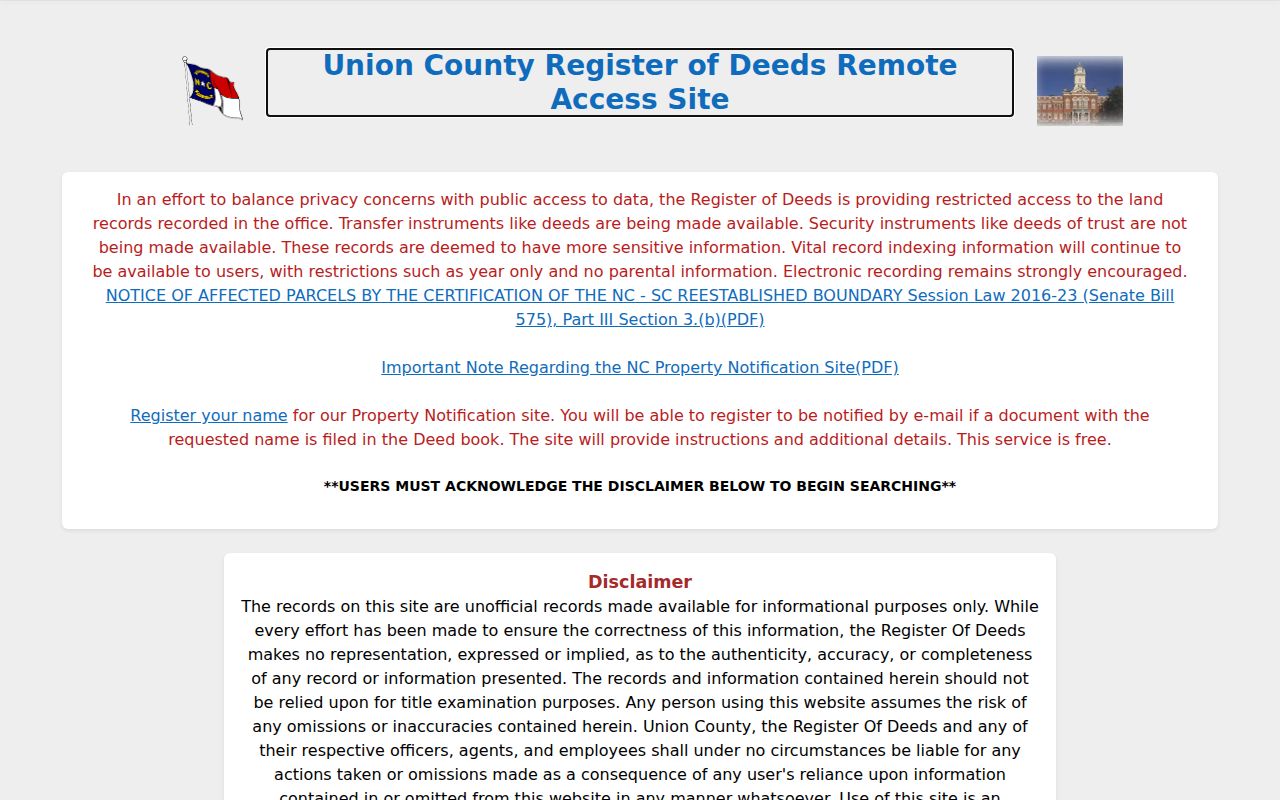
When the application fails, use the Register’s public counter for mortgages, deeds of trust, powers of attorney, assumed names, cancellations, covenants, and uncertain indexing. Bring the party name, date range, and any book, page, or instrument number already found.
- Grantor
- The person or entity giving an interest in a recorded transfer.
- Grantee
- The person or entity receiving that recorded interest.
- Plat
- A recorded map that identifies lots, streets, and subdivision geometry.
- Index
- A finding aid for a document, not the certified document itself.
Note: Follow the book and page references backward to build a chain, and read the document image before drawing a conclusion.
Search Indian Trail Court Records
Union County District and Superior Courts serve Indian Trail. The county moved to eCourts in October 2024. Anonymous users may search public case information without an account through the statewide portal. Smart Search accepts a party, case number, citation, attorney, bar number, business, cross-reference, or nickname, with filters for Union County, case type, status, and filing date.
The portal separates case search from hearing and judgment tools. A case summary can show parties, roles, filing details, a register of actions, events, hearings, dispositions, and public documents. Sealed or expunged files, juvenile matters, adoption records, and protected details remain closed or limited.
| Record route | Useful search | Access |
|---|---|---|
| NC eCourts Portal | Party, business, case, hearing, judgment | Free public web search |
| Union clerk terminal | Defendant, victim or witness, civil, estate | Free inspection at courthouse |
| Union case file | Known case and document | Clerk inspection or copy |
| Federal PACER | Western District party and docket | Account-based docket access |
Indian Trail eCourts File Gaps
A web result may be only the case shell. The Union County Judicial Center has a self-service terminal for criminal, civil, estate, and nonconfidential special-proceeding data. Ask the clerk for the public case file when the portal shows only action dates. Court-file inspection is free, while ordinary North Carolina Judicial Branch copies are listed at twenty-five cents per page.
Older transferred cases belong to the State Archives, not the Town or county request portal. Union divorce files from 1865 through 1968 fill 18.4 cubic feet and are arranged by name. They can include support, custody, alimony, and maiden-name restoration details. Modern divorce judgments come from the clerk that granted them; a state vital event record is a different item.
Note: A visible case number does not mean every filing in that case is open or available online.
Trace Indian Trail Vital Records
The Union County Register of Deeds records and issues certificates for county births, deaths, and marriages. The office offers a counter, mail applications, and linked online ordering. North Carolina Vital Records handles statewide events, amendments, and records beyond the local office’s supported years. Divorce judgments stay with the court clerk, while the state maintains a separate event record.
North Carolina does not apply a simple rule that all births close for one hundred years and deaths for fifty. G.S. 130A-99 permits inspection of county birth and death certificates and indexes subject to protected fields and other limits. Certified copies have separate eligibility rules under G.S. 130A-93. Adoption, medical, witness-protection, and sealed material can add restrictions.
For events before statewide registration began in 1913, turn to county registers, delayed records, probate, church and cemetery records, newspapers, family Bibles, and the State Archives. A missing statewide result from that era is expected and does not prove the event never occurred.
Use Indian Trail Voter Search
The statewide Voter Search can connect a registered name with Union County, status, jurisdictions, a polling place, sample ballot, absentee status, and participation history. First and last name are enough to begin. Year of birth and county narrow common names. Voter history shows whether and how someone participated, including Election Day, early, mail, or provisional voting.
It never reveals candidate or issue choices. Confidential fields include the full date of birth, Social Security and driver-license numbers, a submitted email address, identification images, and a copyable signature. Protected voters can have their residence withheld through the statutory safety process. The full record-set treatment and current file workflow appear in Indian Trail voter registration records.
Search Indian Trail Business Records
A business name can lead to people through the North Carolina Secretary of State. A profile may show the legal name, entity status, formation date, registered agent, office addresses, officials, and filing history. Search assumed names as well. Older local assumed-name filings may remain with the Union County Register of Deeds.
Professional credentials are split among the board that regulates each field. The state publishes separate searches for attorneys, medical professionals, nurses, contractors, real estate licensees, and cosmetic arts. An entity or agent address is not proof of anyone’s home. Treat each entry as a dated official business or licensing fact, then compare it with another reliable identifier.
Search Indian Trail Before 1842
The county name must follow the date. The Indian Trail area belonged to Anson County before 1762, Mecklenburg County from 1762 to 1842, and Union County after its creation in 1842. An early land, estate, court, tax, or marriage search can fail simply because it was aimed at the modern county.
Union archival series begin close to formation. State Archives holdings include apprentice and bastardy bonds, inquests, military-exemption petitions, orphan proceedings, marriage lists, election material, and land records. No sound evidence supports a tale that a catastrophic Union courthouse fire erased the county’s past. Use the surviving series and their specific gaps rather than that myth.
Read Indian Trail Directory History
Confirmed digitized city directories are Monroe and Union County titles, not proven Indian Trail-only editions. Verified volumes include 1922, 1942-43, 1951-52, 1955-56, 1958-59, 1960-61, and 1962-63. Check each book’s coverage rather than assuming every resident of Indian Trail appears. OCR can miss small print, abbreviations, ditto marks, and damaged pages.
Alphabetical and street sections answer different questions. When present, an entry can link a resident to a spouse, occupation, business, address, or a note that the household moved. The absence of a name may reflect the book’s geography, a spelling change, timing, or poor scanning rather than the person’s absence from the area.
Get Indian Trail Genealogy Help
The Dickerson Genealogy and Local History Room at the Main Library in Monroe holds reference sources, historical newspapers, genealogy databases, and photographs. The specialist room is open Monday through Saturday from 9 a.m. to 5 p.m. Contact the genealogy librarian at 704-283-8184 extension 5236 with a surname, time span, place, and record question.
By appointment, the Bookeye5 scanner can handle books, photos, and family papers at up to 600 DPI with a cradle that supports fragile bindings. It can send PDF, JPG, or TIFF files by email or USB. The Union West Regional Library is closer to Indian Trail for general access, but the specialized room is in Monroe.
Church sources also bridge years before surviving directory coverage. Indian Trail Methodist dates to 1901 and Presbyterian to 1913. Ask the congregation or denominational archive about register custody, then compare a church entry with civil, obituary, cemetery, probate, or census evidence.
Find Indian Trail Unclaimed Property
A free name search at NCCash can surface a personal or business name and a last-known location. That can reconnect a search with an older address or entity when current directories have gone quiet. Claims are free. North Carolina says normal processing is about ninety days, although high volume can lengthen it.
The captured state search shows the official route for an Indian Trail name check.
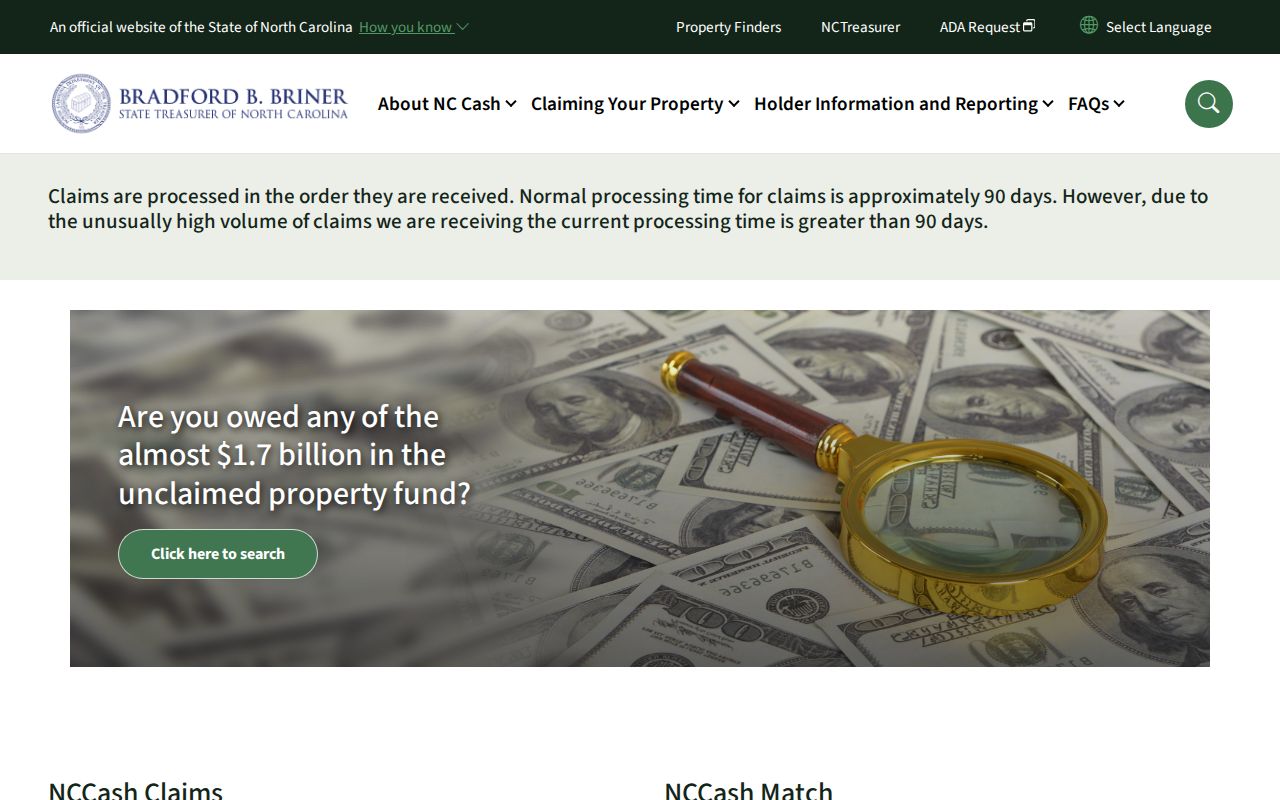
Use the state portal directly. A fee demand from an outside finder is not needed to search or file a claim, and any last-known address should still be checked against source records.
Request Indian Trail Search Records
Use the Town form for records created by Indian Trail. Name the subject, date range, authors or participants, address or project, record class, and preferred electronic format. The Town says any person may request and promises a response within ten days. It may point to a record already posted and does not have to create a report that does not exist.
Use Union County NextRequest for departmental material that is not already online. Court files go directly to the Union Clerk. Deeds and vital certificates go to the Register. Historical transferred records go to the State Archives. A narrow request reaches the right custodian faster and makes cost estimates easier to understand.
Note: Ask for a certified copy only when certification is needed; an index result and an uncertified copy serve different purposes.
Protect Indian Trail Search Subjects
Public access does not permit stalking, threats, harassment, impersonation, or attempts to defeat a protected address. North Carolina’s Address Confidentiality Program gives eligible survivors a substitute address and mail forwarding. Agencies keep the actual address out of new public records subject to the program’s rules and exceptions.
G.S. 132-1.10 also supports a free request to redact listed sensitive identifiers from certain Register of Deeds, court, or Secretary of State filings. The request must identify the document, the protected number, and its exact location. When a compiled profile exposes more than an official source does, respect the official restriction instead of trying to rebuild the hidden data elsewhere.
Lawful use only: Official records support family, estate, civic, property, and personal-safety research. Never use them to stalk, harass, threaten, or harm another person.