
Indian Trail Public Records Landscape
Indian Trail is a town in Union County, not the county seat. That fact controls where most records are kept. Town Hall holds records created by Town staff, boards, planning, and code operations. The deeper land, tax, court, probate, vital, voter, and custody files sit with Union County offices in Monroe or with North Carolina agencies. No single portal covers all of them.
The access level also changes by record and product. A free index can identify a filing without supplying a certified copy. A visible case entry may omit a sealed document. An uncertified vital copy is not the same as a certified certificate. Start with the custodian and access column, then use the specific channel described by that office.
| Record group | Keeper | Remote access | Public access |
|---|---|---|---|
| Town administration, planning, code | Indian Trail Town Clerk | Town request form and posted files | Chapter 132, subject to exemptions |
| Deeds and plats | Union County Register of Deeds | Deed-and-plat index | Index, office inspection, copies |
| Property and tax | Union County Tax and GIS | Tax Inquiry and UC Atlas | Free current portals |
| Court, probate, judgments | Union County Clerk of Superior Court | eCourts Portal | Portal, clerk terminal, case file |
| Birth, death, marriage | Union Register and NC Vital Records | Permitium ordering | Inspection rules differ from certification |
| Custody and offender status | Union Sheriff, NC DAC, NC SBI | Separate current lookups | Public status fields, with exclusions |
Chapter 132 Opens Indian Trail Records
North Carolina Public Records Law defines a government record broadly, regardless of whether it is paper, email, a map, or a database entry. Any person may inspect a public record. State law does not require North Carolina residency or a stated reason. G.S. 132-6 calls for access “as promptly as possible,” but sets no fixed statewide number of days.
A custodian may charge the actual cost of ordinary duplication. Extensive clerical, supervisory, or technology work may support a reasonable special-service charge. The requester may choose a medium the agency can produce, yet the office need not create a report or compile data that does not exist. When access is denied, the office must identify the legal basis and put it in writing if asked. Enforcement under G.S. 132-9 follows a mediation prerequisite before an action to compel access.
- Custodian
- The office or official responsible for keeping and producing a record.
- Index
- A searchable list that points to a filing; it may not include the full image.
- Certified copy
- A copy authenticated by the issuing office for an official purpose.
- Exemption
- A law that closes a record or permits specific facts to be withheld.
Indian Trail Town Records Requests
The Town Clerk is Indian Trail’s custodian under G.S. 132-2, while the online form routes requests through the Communications Director. Use it for Town-created correspondence, council and board material, planning or zoning files, project records, code matters, and local permits. The form collects contact details, delivery preference, a record description, subject, date range, and author names. Those narrowing fields help staff locate the right file without guessing.
The Indian Trail public-record request form shows the exact web submission route.
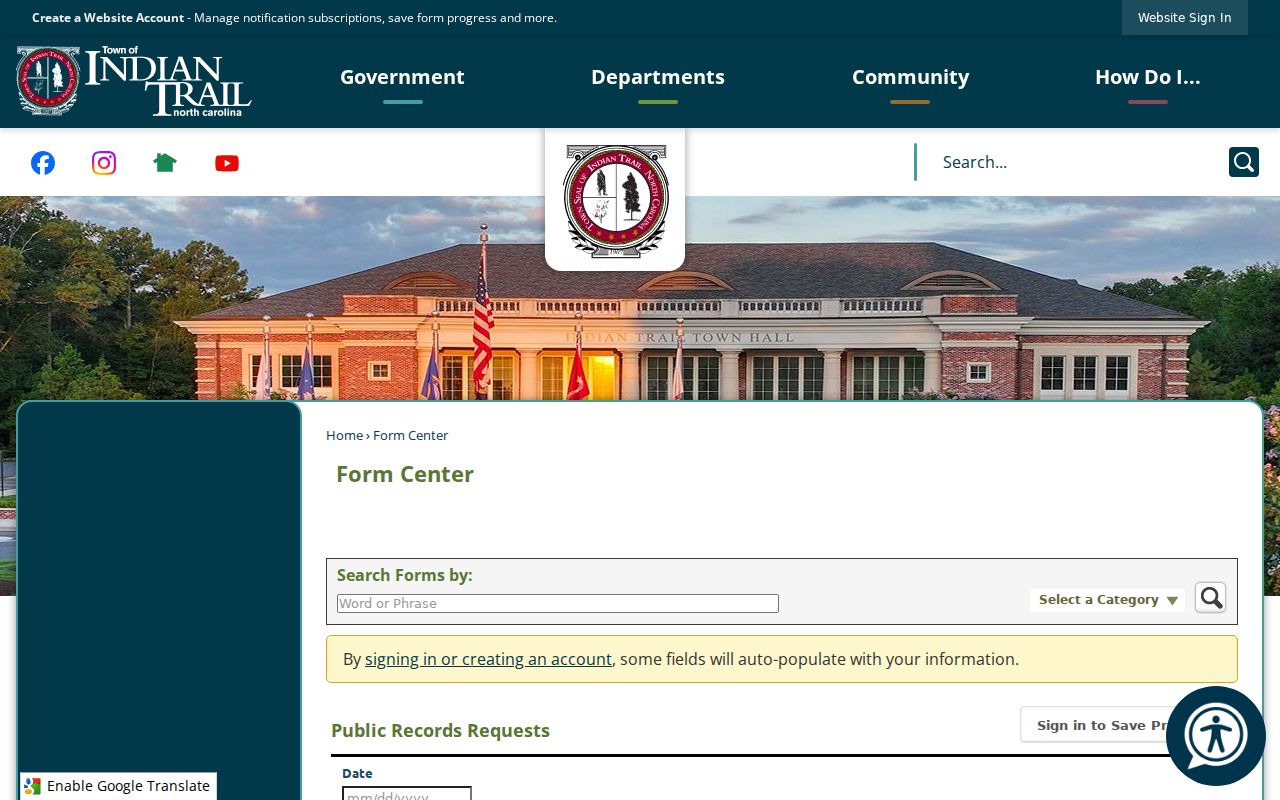
The form’s resident question does not create a residency rule. Town policy says any person may request records. It also asks whether delivery should be by email or mail, giving requesters a direct way to favor a free electronic response when the record exists in that form.
Indian Trail Records Fee Divide
Jurisdiction can change the cost. Indian Trail and Union County each waive the first four staff hours, but the Town charges $18 per hour after that point while the county charges $40 per hour. Union County may combine same-topic requests from one requester submitted within five business days for its fee calculation. County requests are snapshots, not standing requests for future records.
The Town normally provides electronic files at no charge. Its listed prices include five cents per black-and-white page, fifty cents per color page, $5.95 for a flash drive, and $5 for the first certified page plus $2 for each additional page. An estimate above $25 triggers partial prepayment, and full payment is due before release. The Town’s local policy promises a response within ten days, which is more definite than the state standard.
The Town records policy and fee schedule is the source to check before making a large request.
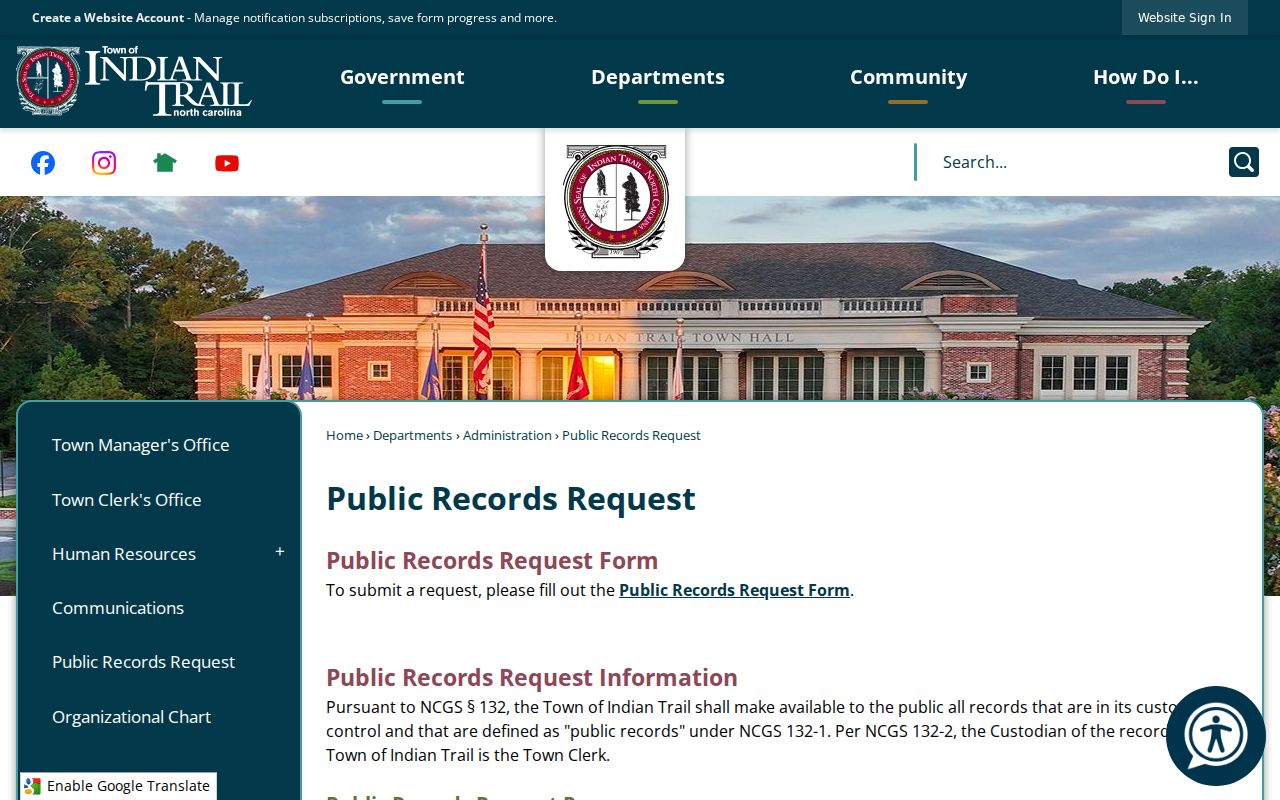
The posted policy makes a narrow electronic request the least costly path. It also explains that Town staff may direct a requester to material already published online.
Note: Confirm whether an address is inside Town limits before choosing the Town form or Union County’s request portal.
Indian Trail Deed Records Limits
The Union County Register of Deeds has served the county since 1842. It records deeds, deeds of trust, cancellations, plats, assumed names, powers of attorney, realty documents, military discharges, and notary records. Its public deed-and-plat system is name-based. The county does not publish a verified online start year, so the web index should not be described as complete back to a guessed date.
One local quirk matters: the public website contains deeds and plats, not mortgages. Address searches also do not identify the owner there. Resolve an address in Tax Inquiry or UC Atlas, capture the exact owner spelling, and move that name into the deed index. If the application fails or a mortgage, covenant, older record, or uncertain spelling is involved, use the second-floor office counter and public terminal at 500 N. Main Street in Monroe.
A mail request should give the document class, indexed party, approximate filing date, and any known book/page or instrument number. Uncertified copies are $1. Certified copies cost $5 for the first page and $2 for each added page. Certification is useful only when an authenticated copy is truly required.
Indian Trail Property Records Mapping
Union County Property Tax Inquiry accepts a property number, owner name, or address in one search box. Advanced filters cover land value, improvement value, total taxable value, acreage, sale price, sale date, municipality, and neighborhood. Selecting Indian Trail as the municipality can narrow results, but a postal address alone does not prove a parcel lies within Town limits.
| Search field | Input | Use |
|---|---|---|
| Property number, owner, address | Combined text | Find the current tax parcel |
| Value and acreage ranges | Number pairs | Narrow similar results |
| Sale price and date | Number and date ranges | Filter transfers |
| Municipality | Dropdown | Select Indian Trail when applicable |
UC Atlas, launched in 2025 to replace GoMAPS, adds parcel geometry, subdivision names, municipality, aerial imagery, nearby lots, measurement tools, and map-extent CSV export. Search fields include owner, parcel number, address, street, subdivision, acreage, and sales. The map is tax and planning information, not a deed, legal description, or boundary survey. Its best role is to resolve geography before a records request.
Indian Trail Court Records After eCourts
Indian Trail has no municipal court. Union County District and Superior Courts, District 30, keep civil, criminal, estate, special-proceeding, judgment, and related files. Union joined eCourts on October 14, 2024. Anonymous users can search the statewide eCourts Portal without an account; signing in adds saved cases but does not unlock protected content.
Smart Search accepts a party, case number, citation, attorney, bar number, business, cross-reference, or nickname. Filters include Union County, party name, case type, status, and filing dates. Separate searches cover hearings and judgments. A typical public case can show its number, type, filing date, status, location, parties and roles, register of actions, events, hearings, dispositions, and public document links. A docket is the running list of filings and events, not always the full file.
The Union County Judicial Center at 400 N. Main Street remains vital. Its self-service terminal can search criminal matters by defendant, case number, or victim/witness, plus civil, estate, and nonconfidential special proceedings. A public kiosk with scanner, printer, and payment services arrived in June 2025. Ask the clerk for the case file when the portal shows only a case shell. Ordinary NCAOC copies are twenty-five cents per page; confirm certification costs with the clerk.
Indian Trail Vital Records Access
The Union County Register records and issues county birth, death, and marriage certificates. NC Vital Records handles statewide records, amendments, and events outside the local office’s supported scope. A divorce judgment comes from the clerk that granted it; the state event record is not the litigated court file.
North Carolina does not follow a simple rule that closes births for one hundred years and deaths for fifty. G.S. 130A-99 allows inspection of county birth and death certificates and indexes subject to protected data, adoption, and other restrictions. G.S. 130A-93 separately limits certified copies to eligible relatives, the subject, authorized representatives, and people with a qualifying legal interest. It also protects specified birth data held by agencies.
For a Union event, the Register’s vital-record page explains counter, mail, and county-linked online ordering. A local certificate is $10 and an uncertified copy is $1. Counter applicants need accepted identification. Mailed requests should use the correct form, proof when required, and a money order rather than cash. Permitium may add verification, shipping, or vendor charges beyond the county base price.
Indian Trail Records Custodian Offices
The right desk depends on who created the file. Town Hall handles Indian Trail administrative material. The Register and Tax offices are at the Union County Government Center. Court case requests go to the Clerk of Superior Court, not to the Town or the county’s general departmental portal. These contacts provide direct fallback routes when a website is incomplete or unavailable.
Indian Trail Town Hall
315 Matthews-Indian Trail Road
Indian Trail, NC 28079
704-821-5401
Town Clerk records desk
Union Register of Deeds
500 N. Main Street, Suite 258
Monroe, NC 28112
704-283-3843
Deeds, plats, and vital records
Tax Administration is at the Government Center, with the assessor reached at 704-283-3746. GIS help is available at 704-292-2619. For county departmental material not already posted, use Union County NextRequest.
Indian Trail Custody Registry Records
Custody information is split among agencies. The Union County Sheriff provides a current inmate inquiry. The NC Department of Adult Correction Offender Public Information search covers public prison, probation, and parole information. Federal custody uses the Bureau of Prisons locator, while the North Carolina Sex Offender and Public Protection Registry is a separate SBI system.
The state offender search illustrates the identifiers used for a precise match.
An offender number is seven digits, and leading zeroes need not be entered. Docket numbers can run to ten digits without punctuation or spaces, while a transport number uses a “T” plus six digits. Medical and treatment information is not public. Registry and custody records should be used for safety and identification, never to harass a listed person.
Note: VINE offers anonymous custody-status alerts, while an online result should still be checked against the responsible agency’s current record.
Protecting Sensitive Indian Trail Records
Open government does not mean every fact is open. Sealed and expunged court files, juvenile and adoption records, protected family or health details, and some criminal investigation material remain closed or limited. G.S. 132-1.4 distinguishes public arrest and incident information from exempt criminal investigation and intelligence records. Federal law also limits access to personal motor-vehicle information.
G.S. 132-1.10 bars unnecessary filing of Social Security, taxpayer, driver-license, passport, financial-account, PIN, and password data in court, Register, and Secretary of State records. A person may submit a free, signed redaction request that identifies the document, sensitive identifier, and exact location. North Carolina’s Address Confidentiality Program gives eligible survivors a substitute address and mail forwarding so an actual address can be kept out of new public files under the program’s rules.
Use records lawfully. Public access supports civic review, family research, fraud checks, and personal safety. Never use an address, registry entry, or case record to stalk, threaten, harass, impersonate, or defeat protected-address safeguards.
Request Indian Trail Public Records
A focused request is easier to locate and less likely to trigger special-service fees. First decide whether the Town, a county department, the Register, the Clerk, or a state agency created the record. Search any official portal that already publishes the material. Then ask for a finite record class and date span instead of every file that mentions a broad topic.
- Choose the custodian. Verify Town boundaries and identify the agency that made or received the record.
- Check posted sources. Use the relevant index, eCourts, Tax Inquiry, UC Atlas, or agency record page first.
- Describe the file. Give names and variants, subject, date range, address, parcel, case number, book/page, or author when known.
- Select the product. State the desired electronic or paper format and whether an uncertified or certified copy is needed.
- Review the response. Narrow a costly request, ask for the legal basis of a denial in writing, and use Chapter 132’s mediation and enforcement route when appropriate.
Town-created files belong on the Indian Trail form. Union departmental records not online go through NextRequest. Deed, court, and vital requests should stay with their specialized custodians because the general portals cannot bypass indexing limits, case-file rules, or certified-copy eligibility. Clear routing saves time and preserves the difference between a useful lead and an official record.